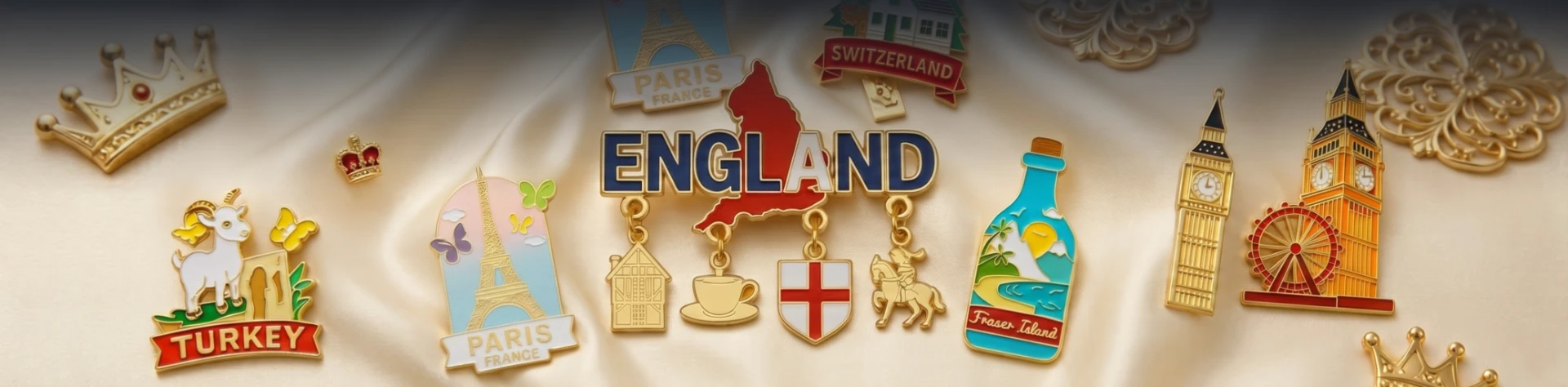
Custom Metal Car Diffuser Vent Clip: B2B Finish Guide
Time : Nov 05, 2026 View : 26
Sourcing & Engineering Takeaways:
- Hard enamel (imitation cloisonné) and baked soft lacquer provide scratch-resistant 3H to 4H jewelry finishes, but soft lacquer requires a 0.35 mm (0.014″) minimum recess to contain liquid color during 140°C to 160°C (284°F to 320°F) baking.
- For complex photographic graphics and multi-color gradients, optical-grade anti-UV polyurethane (PU) crystal domes prevent yellowing and thermal shrinkage across cabin extremes from -40°C to 80°C (-40°F to 176°F), whereas low-cost commercial epoxies degrade within weeks.
- Genuine sheepskin and Nappa leather inlays demand CNC-machined 0.5 mm to 0.8 mm (0.020″ to 0.031″) recessed seating basins with 3M VHB automotive acrylic adhesive, counteracting cabin HVAC airflow shear forces and preventing edge delamination.
- Sintered NdFeB N52H magnets rated for operating temperatures up to 120°C (248°F) and chemical-resistant PBT diffuser cavities are non-negotiable baselines to prevent irreversible demagnetization and terpene stress cracking.
Under direct summer sunlight, a vehicle cabin reaches 80°C (176°F), only to be blasted by 65°C (149°F) heating cycles in winter while bathed in volatile terpene fragrance vapors. Sourcing a custom metal car diffuser vent clip requires balancing tactile dashboard aesthetics against raw thermal and chemical realities. Selecting the wrong emblem finish or assembly method causes unsightly epoxy yellowing, adhesive shearing, and fragrance oil corrosion that ruins brand prestige.
Automotive interiors amplify physical defects that consumer jewelry never experiences. A decorative badge sitting comfortably on a lapel faces room-temperature ambient air, but when clipped to an automobile air vent, it becomes a micro-aerodynamic assembly subject to mechanical vibration, cyclic temperature spikes, and continuous chemical exposure from solvent-rich essential oils. Engineering a durable vent clip diffuser demands matching surface decorative techniques with robust mechanical pocketing and chemical-resistant sub-assemblies.
Topographic Distinction: How Five Distinct Emblem Finishes Behave in Automotive Cabins
Selecting an emblem finish for a custom metal car diffuser vent clip dictates whether the faceplate is manually ground with watering stones, cured with optical polyurethane, or inlaid with laser-cut sheepskin leather. Each decorative technique interacts differently with vehicle cabin heat, UV sunlight, and volatile fragrance chemistry.
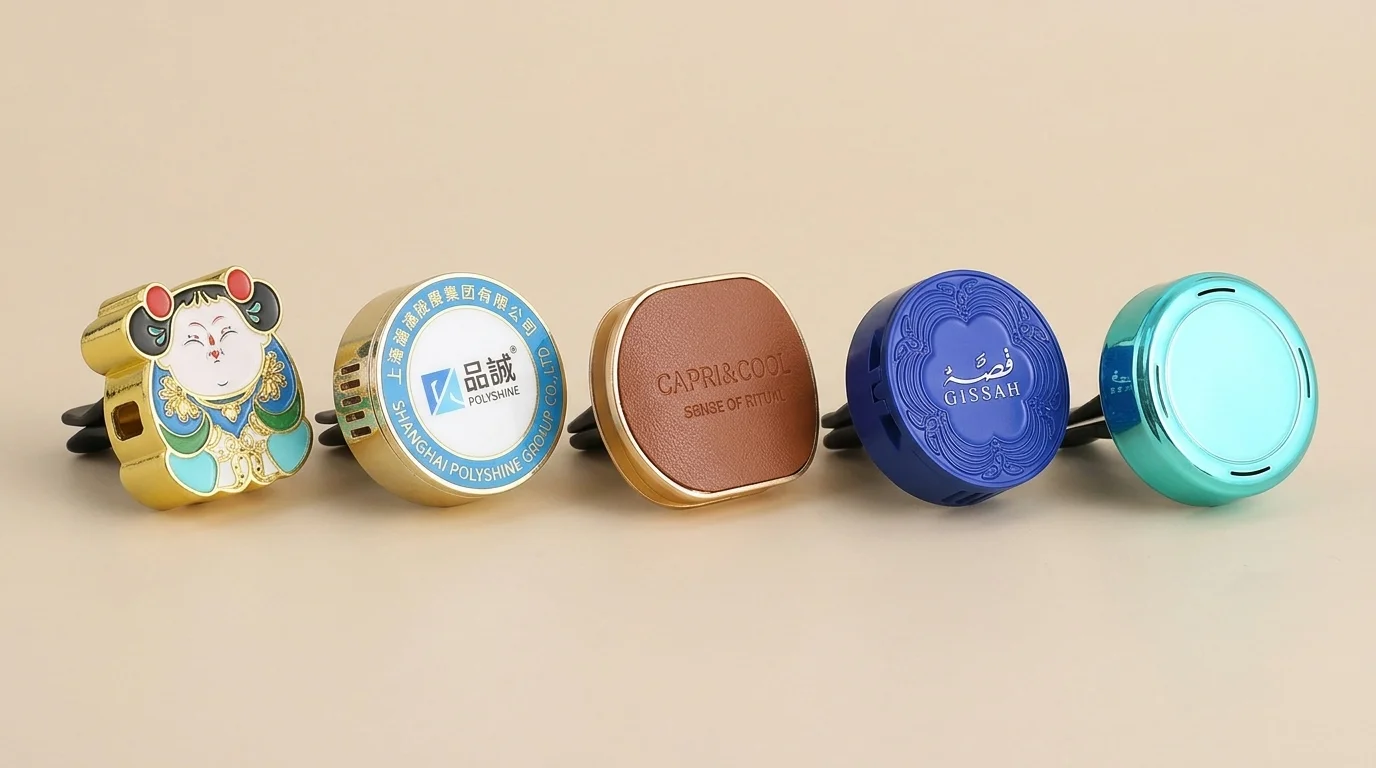
Car aromatherapy diffuser guide
Imitation Hard Enamel (Synthetic Cloisonné)
In imitation hard enamel processing, polyester-modified epoxy resin is filled past the metal dividing ridges of a die-cast Zamak 3 zinc alloy blank. After baking at 160°C to 200°C (320°F to 392°F), lapidary technicians grind the face against high-speed rotating carborundum watering stones under constant coolant flow. The abrasive stone mills down the cured resin and raised metal lines simultaneously, creating a single co-planar, mirror-flat surface with a pencil hardness of 3H to 4H. For high-end automotive brands and collector club accessories, hard enamel offers lifelong scratch resistance and imperviousness to aromatic solvents.
Soft Lacquer Enamel (Dimensional Paint Process)
Soft lacquer enamel utilizes automated pneumatic syringe dispensing into recessed cavities. As the amino-alkyd resin bakes at 140°C to 160°C (284°F to 320°F), solvent evaporation and liquid meniscus surface tension pull the pigment downward, leaving colors recessed 0.15 mm to 0.30 mm (0.006″ to 0.012″) beneath the polished metal ribs. This creates dramatic visual depth and crisp tactile ridges. Finished blanks receive an electrodeposited automotive electroplating finish—such as bright chrome, 24K real gold, or satin pearl nickel—sealed with a baked anti-oxidation AP clear coat (8 μm to 12 μm (315 μin to 472 μin), 3H hardness) to withstand finger perspiration and oil vapors.
Offset Printing with Anti-UV Polyurethane Crystal Dome
When brand designs feature fine halftone screening, intricate photographic textures, or micro-text below 0.20 mm (0.008″), chemical enamel filling reaches its physical resolution limit. Offset lithography transfers four-color process inks directly onto treated metal blanks or high-adhesion synthetic substrates. The printed surface is subsequently encapsulated beneath an optical-grade modified polyurethane (PU) crystal dome measuring 0.8 mm to 1.5 mm (0.031″ to 0.059″) thick. Unlike cheap commercial epoxy resins that turn yellow, shrink, and curl under intense windshield UV rays, automotive-grade PU remains water-clear from -40°C to 90°C (-40°F to 194°F) while providing a high-gloss magnifying lens effect.
High-Precision UV Flatbed Digital Printing
For short-run programs, multi-variant regional releases, or fine fine-art reproductions (such as museum paintings or multi-shade botanical illustrations), UV digital flatbed printing deposits photopolymer inks directly onto primed metal surfaces. Instant curing under high-intensity UV LED lamps polymerizes ink droplets on contact, eliminating die tooling fees and chemical film screens. When finished with a high-temperature clear protective lacquer, UV digital prints achieve vibrant color saturation with tight registration on flat metal inserts.
Genuine Sheepskin and Luxury Leather Inlays
For luxury vehicle cockpits, genuine sheepskin and top-grain Nappa leather deliver bespoke warmth that metal alone cannot match. Full-grain natural sheepskin is precision cut using CNC laser cutters or steel rule dies to exact perimeter dimensions. Every hide displays organic grain variations, ensuring that no two pieces are identical. The leather face is bonded into a dedicated recessed bezel using high-shear acrylic film, offering an ultra-premium sensory presentation that integrates directly into leather-trimmed dashboards.
| Engineering Parameter | Imitation Hard Enamel | Soft Lacquer Enamel | Offset Print + Anti-UV PU Dome | UV Digital Flatbed Print | Genuine Sheepskin Inlay |
|---|---|---|---|---|---|
| Surface Topography | Mirror-flat, co-planar | Recessed wells (0.15–0.30 mm) | Smooth convex clear dome (0.8–1.5 mm) | Flat micro-matte texture | Textured organic leather grain |
| Thermal Resistance | Up to 120°C (248°F) continuous | Up to 100°C (212°F) continuous | -40°C to 90°C (-40°F to 194°F) | Up to 90°C (194°F) continuous | Up to 85°C (185°F) continuous |
| UV Solar Stability | Outstanding (zero fading/yellowing) | High (stable automotive pigments) | Excellent (automotive-grade PU) | High (UV-curable industrial ink) | Good (requires UV topcoat seal) |
| Terpene Chemical Barrier | Completely impervious | High (with baked AP clear coat) | Hermetically sealed by PU dome | Moderate (requires clear lacquer) | Physical isolation required |
| Resolution / Detail Limit | Vector lines ≥ 0.25 mm (0.010″) | Vector lines ≥ 0.20 mm (0.008″) | Micro-dot photo print (≥1200 DPI) | Full digital CMYK (≥1440 DPI) | Laser-cut perimeter contour |
| Tooling & Setup Cost | High (custom die + grinding jig) | Moderate (custom stamping/casting die) | Moderate (print plate + dispensing) | Low (direct digital tooling-free) | Moderate (CNC cutting dies) |
| Recommended Order Scale | 1,000 to 10,000+ units | 500 to 20,000+ units | 1,000 to 10,000+ units | 200 to 2,000 units | 500 to 5,000 units |
Mechanical Retention and Chemical Barrier: Precision Tooling & Engineering for Recessed Pockets and N52H Magnets
Flat surface-mounted emblems and commercial adhesives fail rapidly in automotive vents because cabin HVAC airflow and road vibrations generate continuous peel and shear stresses. When an air conditioner blows warm air at 45°C to 65°C (113°F to 149°F), standard pressure-sensitive adhesives soften. If volatile fragrance oil condenses around the adhesive margin, solvent migration accelerates edge peeling until the front emblem drops off the vehicle dash.
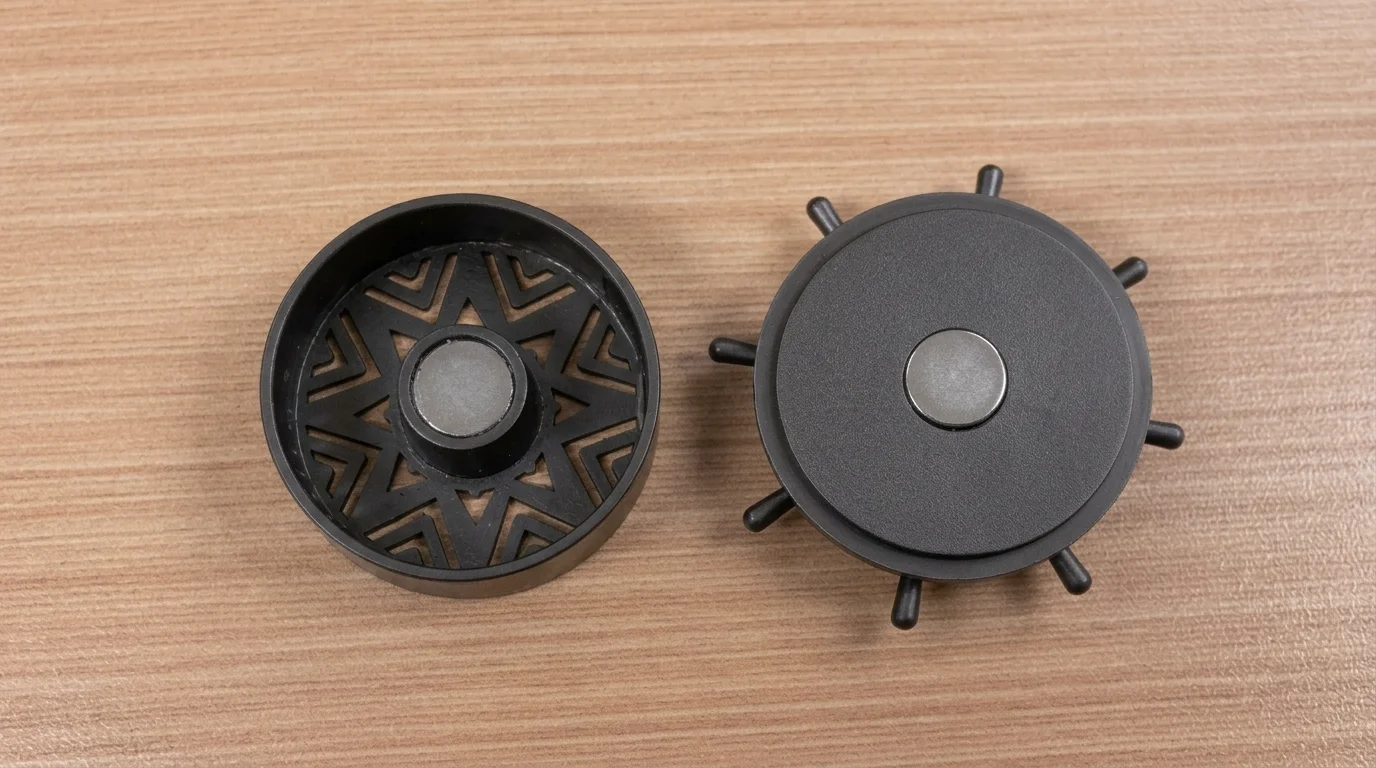
car diffuser vent clip magnet
To eliminate field failures, our engineering team enforces four mechanical and material baselines:
- Recessed Seating Basins (0.3 mm to 0.5 mm (0.012″ to 0.020″)): Rather than gluing emblems onto flat zinc surfaces, our casting molds incorporate an engineered perimeter recess. For metal badges and PU domes, the recess measures 0.3 mm to 0.5 mm (0.012″ to 0.020″) deep; for leather inlays, the basin depth increases to 0.5 mm to 0.8 mm (0.020″ to 0.031″). The cast zinc sidewalls physically absorb side-impact shear forces caused by vehicle bumps and fingers adjusting vent louvers. Crucially, the sidewall stops volatile fragrance vapors from penetrating adhesive bond lines.
- Sintered NdFeB N52H High-Temperature Magnets: For two-piece magnetic diffusers that allow drivers to change fragrance wicks with one hand, magnet selection is critical. Standard commercial N35 magnets experience irreversible thermal demagnetization when temperatures exceed 60°C to 80°C (140°F to 176°F), causing the heavy metal faceplate to rattle loose. We utilize automotive-grade sintered NdFeB N52H or N52M magnets rated for continuous service up to 120°C (248°F). Magnet surfaces feature Ni-Cu-Ni triple electroplating or sealed epoxy encapsulation, recessed within custom tooling pockets with a 0.10 mm (0.004″) adhesive overflow gap.
- Oil-Resistant PBT/POM Diffuser Cavities: Fragrance oils contain concentrated monoterpenes (such as d-limonene) and ester solvents. If standard commodity ABS or polystyrene (PS) is used for the rear scent cavity, the plastic swells, develops environmental stress cracking (ESC), and cracks within weeks. We construct diffuser ventilation chambers exclusively from chemical-resistant PBT (polybutylene terephthalate), POM (polyoxymethylene), or CNC-machined 6061 anodized aluminum.
- Cross-Clip with LSR Silicone Sleeve: The vent attachment mechanism features a manganese spring steel core overmolded with food-grade liquid silicone rubber (LSR, Shore A 55°, heat resistance ≥200°C (392°F)), produced to our engineering specifications. The universal cross-clip pattern slides securely over both horizontal and vertical louvers without scratching vehicle vent paint, maintaining an extraction pull force of ≥35 N (7.87 lbf) so the clip never remains stuck on the louver when pulled.
⚠️ Engineering & Assembly Red Line: Never use commercial hot-melt glue or general-purpose stationer tape to secure automotive emblem inlays. Every bonded component must utilize automotive-grade 3M VHB modified acrylic adhesive film (rated for -40°C to +90°C (-40°F to +194°F)), applied only after degreasing metal pockets with isopropyl alcohol (IPA) and wiping with 3M 94 adhesion promoter.
Commercial Unit Economics: Balancing Tooling Amortization and Cabin Luxury Positioning
Tooling amortization across a 500-piece pilot run versus a 10,000-piece volume contract dictates whether digital UV printing or multi-stage hard enamel delivers the lowest landed cost per unit. Sourcing directors must evaluate unit economics alongside vehicle brand tiering.
- Pilot Programs & Multi-SKU Launches (200 to 1,000 Units): For initial retail market testing, boutique automotive lifestyle merch, or projects requiring 10 different artwork variations, UV flatbed printing and PU crystal domes minimize initial capital outlay. Digital printing eliminates screen setup fees and tooling lead times, enabling physical sample sign-off within 3 to 7 business days.
- Volume Fleet & Tier-1 Branded Production (2,000 to 20,000+ Units): When producing corporate dealership handover gifts, airline branded merchandise, or high-volume aftermarket accessories, hard enamel and soft lacquer become highly economical. While hard enamel incurs higher initial die-engraving and stone-polishing costs, amortization drops tooling expense to pennies per unit over volume runs. Our high-pressure zinc die-casting molds maintain a working lifespan of 50,000 to 100,000 shots, ensuring zero recurring mold charges on re-orders.
- Luxury Automotive Customization (500 to 5,000 Units): For bespoke luxury vehicle editions, combining heavy Zamak 3 zinc alloy bodies with genuine sheepskin or Nappa leather inlays justifies high retail price points ($25 to $50+ MSRP). The rich tactile contrast between cold, electroplated polished metal bezels and soft, organic grain leather resonates strongly with luxury vehicle owners.
💡 Factory Rule of Thumb: Because automotive faceplates frequently come into contact with hands adjusting HVAC airflow, soft enamel and printed inserts should always receive our automotive-grade anti-oxidation AP clear coat. Cured at 150°C (302°F) to an 8 μm to 12 μm (315 μin to 472 μin) thickness, this invisible shield provides 3H pencil hardness that resists finger oils, acidic sweat, and surface micro-scratching.
Our facility operates integrated metal manufacturing capabilities from precision CNC mold-making and high-speed Zamak casting to precision color dispensing and automotive plating baths. Partnering directly with our engineering team ensures that every component—from spring steel clips to magnetic faceplates—is validated for vehicle operating conditions.
4. Pre-Shipment Reliability Benchmarks: Six Thermal and Chemical Audits for Car Vent Hardware
Pre-production golden samples must satisfy six simulated automotive cabin stress tests before releasing volume die-casting lines:
- Thermal Shock Chamber Cycling: Samples undergo continuous testing in an environmental chamber cycling between -40°C (-40°F) for 2 hours and 80°C (176°F) for 2 hours across 24 hours (6 full cycles). Inserts must exhibit zero delamination, blistering, edge curling, or adhesive softening.
- Simulated HVAC Hot Air Exposure: Assembled diffusers are mounted before a 65°C (149°F) heated air stream for 4 continuous hours. Magnetic coupling retention and adhesive lap shear strength must maintain ≥95% of initial baseline holding force.
- Fragrance Oil Vapor Chamber Exposure: Assembled units are sealed inside an environmental desiccator containing saturated volatile fragrance oil vapors (monoterpenes and citrus esters) at 50°C (122°F) for 48 hours. Plastic cavities, PU domes, and silicone clip sleeves must show zero swelling, whitening, cracking, or surface tackiness.
- Cross-Hatch Plating Adhesion: In accordance with ASTM D3359 Method B and ISO 2409, a cross-hatch lattice is scribed through metal electroplating and lacquer layers. After applying and rapidly peeling 3M 600 pressure tape, the detachment rate must be exactly 0% (5B rating).
- Vent Clip Extraction Retention Test: The manganese steel and LSR silicone clip is inserted onto an automotive air vent blade. A digital force gauge measures the axial pull-off tension. The clip must deliver an extraction resistance of ≥35 N (7.87 lbf), preventing unintended detachment while remaining gentle on original vehicle louvers.
- International Chemical & Magnet Safety: All metal substrates meet RoHS 2.0 (10 substances) and European REACH Annex XVII restrictions for Lead (Entry 63), Cadmium (Entry 23), and Nickel release (<0.5 μg/cm²/week per EN 1811:2023). Fragrance media formulations align with the IFRA 51st Amendment, and magnetic elements satisfy 16 CFR 1262 flux density safety benchmarks.
📋 Copy-Paste Spec for Your Custom Car Diffuser Vent Clip RFQ:
- Front Emblem Base: Die-Cast Zamak 3 Zinc Alloy (density 6.6–6.7 g/cm³) with 0.35 mm (0.014″) raised borders
- Emblem Finish Option: Imitation Hard Enamel (stone ground flush) / Soft Lacquer (with AP clear coat) / Anti-UV PU Crystal Dome / UV Digital Print / Genuine Sheepskin Inlay
- Perimeter Retention: 0.3 mm to 0.5 mm (0.012″ to 0.020″) CNC recessed seating basin (0.5 mm to 0.8 mm (0.020″ to 0.031″) for leather)
- Magnetic Mechanism: Sintered NdFeB N52H / N52M high-temperature magnets (working temperature ≥120°C (248°F), Ni-Cu-Ni coated)
- Diffuser Cavity: Chemical-resistant PBT engineering polymer or 6061 CNC anodized aluminum (ABS/PS strictly prohibited)
- Vent Attachment: Manganese spring steel core overmolded with food-grade liquid silicone rubber (LSR Shore A 55°, cross-clip configuration)
- Adhesive Standard: 3M VHB 5952 / 4910 high-temperature acrylic adhesive film with IPA degreasing and 3M 94 primer
- Diffuser Scent Core: High-density porous PE fiber wick or microporous sintered ceramic tablet (solid-state slow release)
- Environmental Compliance: REACH Annex XVII, RoHS 2.0, EN 1811:2023 nickel-free, IFRA 51st Amendment, 16 CFR 1262 magnet safety
Frequently Asked Questions
Why does conventional epoxy dome yellow and curl in car vent diffusers?
Conventional epoxy resin degrades rapidly under vehicle windshield UV radiation and solar heat spikes above 65°C (149°F). The aromatic amine hardeners oxidize, causing noticeable yellow discoloration within 30 to 60 days, while thermal shrinkage generates inward curling stresses that pop the dome out of its bezel. In contrast, automotive-grade polyurethane (PU) domes utilize aliphatic isocyanate cross-linkers that remain optically clear, flexible, and chemically inert against volatile fragrance vapors across -40°C to 90°C (-40°F to 194°F).
How does a recessed seating pocket prevent emblem delamination during winter heating?
When an automobile heater operates, warm airflow expanding out of vent louvers reaches 45°C to 65°C (113°F to 149°F). On flat metal surfaces, warm air exerts continuous peeling shear across exposed adhesive edges, while aromatic oil vapors wick into the boundary layer. By counter-sinking the emblem inside a 0.3 mm to 0.5 mm (0.012″ to 0.020″) recessed cast zinc basin, the rigid perimeter sidewalls physically block air currents, shield the adhesive margin from chemical ingress, and mechanically lock the decorative face against lateral shearing forces.
Can custom car diffusers combine multiple finishes like soft enamel and UV digital print?
Yes. Hybrid manufacturing is a specialty of our tooling facility. For intricate heraldic crests, corporate mascot emblems, or commemorative automotive badges, we frequently die-cast the primary outer housing in Zamak 3, apply polished electroplating and recessed soft enamel to bold graphic borders, and execute high-resolution secondary UV flatbed printing across central portrait zones. The entire composite assembly is then protected with our baked automotive AP clear coat to lock in color vibrancy.
Engineer Your Custom Car Diffuser Vent Clip Program
Direct factory engineering bridges aesthetic brand design with automotive durability standards. Gold Valley’s engineering team provides end-to-end technical support from CAD airflow optimization and magnet flux calculation to volume production.
- Option A (Engineering CAD & Finish Feasibility Review): Send your 2D artwork (
.AI,.EPS,.PDF) or 3D CAD files (.STEP,.IGS). Our tooling engineers will inspect draft angles, perimeter recess depths, and finish compatibility, providing a comprehensive DFM assessment within 2 to 4 hours. - Option B (Custom Prototyping & Pilot Manufacturing): Preparing a commercial custom project? Submit your vector artwork and project specifications for rapid 3 to 7 business day physical prototyping, followed by 12 to 18 business day volume production runs.
Request Your Custom DFM Review & Prototyping