Pin Attachment Hardware: How to Choose the Right Backing for Custom Pins and Badges
Time : Oct 15, 2026 View : 31
Quick Selection & Sourcing Takeaways:
- Match fabric first: Stamped butterfly clutches and soft rubber clutches suit everyday cotton, denim, and canvas; magnetic backings protect fine silk, cashmere, and tailored suits from permanent pinholes.
- Prioritize wearer comfort: Rubber PVC clutches sit flush and gentle against bare skin (ideal for t-shirts and hats), while butterfly clutches offer classic metal click-retention for jackets and tote bags.
- Zero-drop security for collectors: Deluxe flat-top locking backs utilize an internal ball-detent mechanism holding up to 10 kgf (22 lbf) of pull-out force—essential for festival backpacks and valuable collector pins.
- The Anti-Spin Rule: Any badge wider than 30 mm (1.2″) or top-heavy in shape requires two spur posts spaced at least 15 mm (0.6″) apart to prevent the design from rotating upside down during wear.
The artwork on the front of a custom pin gets all the creative attention during sampling. But what determines whether that pin remains proudly worn or ends up lost in a parking lot is the half-inch of hardware fastened to the back. A loose clutch, an uncomfortable metal point poking the wearer’s neck, or a post tearing through a delicate blouse turns a beautiful promotional piece into a quality complaint.
Backing hardware is often the smallest line item on a manufacturing quote, yet it completely defines how the end user interacts with your pin. At our Dongguan facility, we fit six primary attachment configurations across millions of lapel pins, brooches, and badge programs each year. Below is a practical guide to each backing option, comparing tactile feel, holding security, garment compatibility, and retail presentation.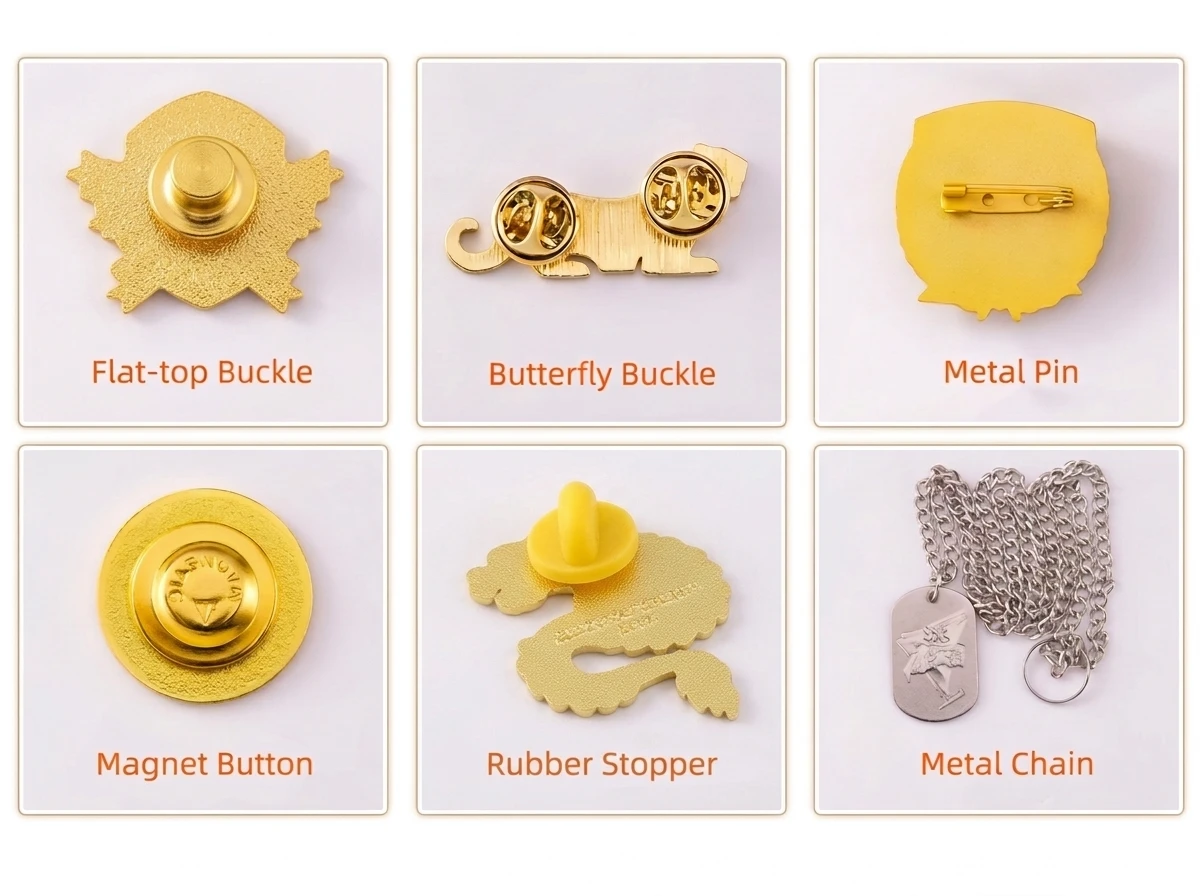
1. Pin Backing Options at a Glance: The Complete Comparison Matrix
Selecting the right attachment starts with two questions: What garment will this pin attach to? and How active is the wearer?
| Backing Option | Mechanism & Construction | Tactile Feel & Profile | Retention Security | Best Fit & Use Cases | Key Trade-Off |
|---|---|---|---|---|---|
| Butterfly Clutch (Metal Military Clutch) | Stamped brass shell with dual internal spring-friction jaws | Classic metal click; low profile, bare rear wings | ~2 kgf friction grip; adequate for daily wear | Conference giveaways, tote bags, denim jackets, promotional runs | Metal wings can press uncomfortably against skin under tight shirts |
| Rubber Clutch (PVC Cap) | Injection-molded synthetic rubber / soft PVC cap with central channel | Soft, smooth, skin-friendly; flat against bare skin | Snug friction hold; gentle on post plating | Streetwear, hats, t-shirts, anime merch, retail pin cards | Can loosen over years if repeatedly removed and re-inserted |
| Deluxe Flat-Top Lock (Ball-Detent Lock) | CNC-turned brass housing with internal spring-loaded steel ball | Solid, premium weight; smooth flat rear cap | ≥ 10 kgf mechanical lock; requires pull-to-release | Collector pins, festival backpacks, leather vests, corporate awards | Higher unit cost; sits ~4 mm proud behind the fabric |
| Magnetic Backing (2-Piece No-Hole Plate) | Sintered NdFeB magnets (N35/N42) paired with nickel-plated steel plate | Completely flat; zero garment puncture | ~800 g vertical magnetic hold; suit-weight capacity | Silk blouses, cashmere coats, bespoke suiting, nurse nameplates | Not suitable for active sports or heavy thick overcoats; keep clear of pacemakers |
| Safety Pin (Brooch Bar Pin) | Stainless steel horizontal bar with rotating safety catch | Broad horizontal bar; distributes weight across 30–50 mm | High mechanical hold; pin cannot pull through | Badges > 40 mm (1.6″), heavy 3D crests, sash rosettes, uniforms | Requires larger fabric puncture; visible behind translucent fabrics |
| Keyring & Dangle Chain | Tempered spring steel split ring (Φ28–32 mm) or plated drop link chain | Dynamic multi-piece motion; dual-purpose accessory | 150 N assembly tensile strength | Bag charms, 2-in-1 retail products, convention swag, commemorative gifts | Adds assembly labor; requires a dedicated top mounting eyelet |
2. The Daily Classics: Butterfly Clutch vs. Color-Matched Rubber Clutch
For standard lapel pins between 20 mm and 30 mm (0.75″ to 1.2″), the choice almost always comes down to two everyday champions: the stamped butterfly clutch and the soft rubber clutch.
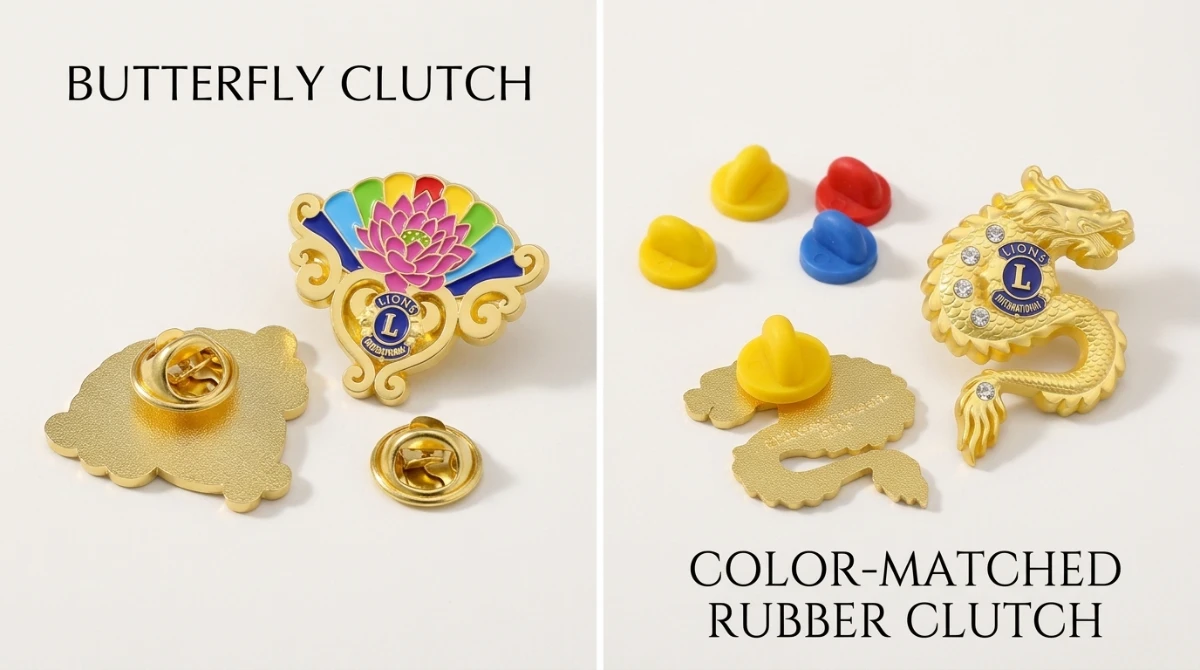
The Butterfly Clutch (Military Clutch)
The butterfly clutch has been the industry standard for over a century. Two stamped brass wings compress a tempered internal spring strip to clamp the needle post.
- The Look & Feel: It delivers a familiar, tactile “snap” when pressed into place. It adds a traditional, authentic feel that works particularly well with antique brass, vintage military badges, and formal blazer lapels.
- Best Applications: High-volume corporate events, trade show giveaways, denim jackets, and canvas bags where low unit cost and fast attachment matter most.
- Consideration: Because the brass wings have defined edges, they can occasionally rub or snag against bare skin if worn on a thin cotton t-shirt.
The Rubber Clutch (PVC Pin Back)
In retail merchandise, streetwear, and creator pin communities, rubber clutches have become the overwhelmingly preferred standard.
- The Look & Feel: Made from durable, high-density PVC, rubber clutches are completely smooth and soft to the touch. They eliminate the scratchy feel of metal wings, making them comfortable to wear directly against the chest or on a baseball cap.
- Aesthetic Versatility: Unlike metal clutches, rubber backs can be molded in custom Pantone colors—classic black, bright red, pastel pink, glow-in-the-dark green, or even novelty shapes (hearts, stars, and cat heads) to match the pin’s front artwork.
- Best Applications: Retail-ready enamel pins, anime/gaming merchandise, kids’ apparel, hats, and everyday streetwear.
3. Zero-Drop Security: Deluxe Flat-Top Locking Backs
Every pin enthusiast has experienced the heartbreak of looking down at a jacket or backpack and discovering an empty needle where a prized collector’s pin used to sit.
Friction clutches hold roughly 2 kgf of force, which is plenty for office wear. But brushing against a subway turnstile, sliding a heavy backpack strap over your shoulder, or navigating a crowded festival can easily exert 3 to 5 kgf of lateral shear—popping a friction clutch clean off.
How the Locking Mechanism Works
The deluxe flat-top lock (often called a deluxe clutch or jewelry lock) replaces friction with positive mechanical locking:
- An internal miniature steel ball seats firmly into an annular groove precision-machined near the tip of the spur post.
- The harder you pull on the badge body, the tighter the ball wedges into the groove. It resists up to 10 kgf (22 lbf) of direct axial pull-out.
- To remove the pin, you must intentionally pull back the spring-loaded outer cap with your fingertips. No Allen keys or tiny screwdrivers are needed.
When to Upgrade to Deluxe Locks
- High-Value Pins: Limited-edition collector series, numbered challenge pins, and genuine gold/silver corporate anniversary emblems.
- High-Motion Gear: Pins displayed on leather motorcycle vests, travel backpacks, denim jackets, and convention lanyards.
- Sleek Profile: The flat exterior sits flush and comfortable against the body, avoiding the sharp protrusion of wing-style clutches.
4. Fabric Savers & Heavy Hitters: Magnetic Backings vs. Safety Brooch Pins
When standard spur posts fail to match the garment or the pin’s physical weight, magnetic plates and safety brooch pins take over.
Magnetic Backings: 100% No-Hole Protection
Traditional posts pierce woven threads. On denim or heavy cotton, the weave heals around the puncture. But on cashmere, silk, satin, and tailored tropical wool, a 1.2 mm brass post permanently cuts or distorts warp and weft yarns, ruining an expensive garment.
- The Build: Our magnetic fasteners feature a twin-disc sintered NdFeB (neodymium) magnet cluster paired with a nickel-plated steel counterplate.
- Holding Strength: It delivers ≥ 800 g (1.8 lb) of direct vertical clamping force through suit lapels, dress shirts, and knitwear without slipping.
- Ideal Uses: Executive gifts, gala lapel pins, formal evening wear, medical/dental uniform tags, and luxury hospitality staff badges.
- Wearer Note: Always remind wearers with implanted cardiac pacemakers to avoid magnetic accessories, and avoid using magnets on thick, heavy wool overcoats where fabric thickness dampens magnetic flux.
Safety Brooch Pins: Broad Weight Distribution
When a badge exceeds 40 mm (1.6″) in diameter or weighs over 30 grams (such as heavy 3D zinc alloy crests, ceremonial medals, or employee service bars), concentrated spur posts can tear or sag the fabric.
- The Build: A horizontal stainless steel pin stem mounted across a 30 mm to 50 mm base bar, equipped with a rotating safety catch that locks the needle tip securely inside a housing.
- Why It Works: The wide horizontal footprint spreads mechanical load evenly across a broad swath of fabric, keeping heavy insignias standing upright and flat.
- Ideal Uses: Uniform badges, hospital identification pins, oversized vintage brooches, and ribbon sash medals.
5. Creative Conversions: Turn Pins into Keychains & Dangle Jewelry
Why limit a custom design to lapel wear? Adding simple hardware conversions at the mold or final-assembly stage allows a single piece of tooling to serve multiple product categories.
1. Keyring Conversions (2-in-1 Merch)
By casting or stamping a small, reinforced eyelet at the top edge of your badge design, the piece transforms instantly into a high-perceived-value keychain or bag charm.
- We fit a Φ28 mm to Φ32 mm tempered flat split ring in matching electroplated gold, nickel, or black nickel.
- The mounting eyelet is chamfered with an R 0.3 mm radius so the jump ring articulates freely without binding or wearing through.
- Commercial Benefit: You can order 500 units from the same mold and split the batch: 300 pins with rubber clutches for retail display cards, and 200 keychains for gift-box sets.
2. Dangle Chains & Articulated Elements
Dangle pins feature a secondary mini-charm (such as a dangling crystal, dropped logo, or hanging year bar) linked to the primary badge via a 15 mm to 30 mm plated chain.
- Adds dynamic, jewelry-like movement that catches light and draws visual interest.
- Perfect for commemorative milestones (e.g., a “2026” bar dangling from an association crest), fantasy anime characters holding drop weapons, or award pins with dropped service stars.
6. The Post Placement Rule: 1 Post vs. 2 Posts (Preventing the “Spin”)
One of the most common quality oversights in custom badge design has nothing to do with the clutch itself—it is the number and spacing of the spur posts on the badge back.
Have you ever worn a pin that constantly rotated upside down or tilted sideways within an hour? That is caused by rotational torque on a single post.
The Toolroom Rule of Thumb:
- Single Center Post:
– Suitable only for round, square, or symmetrical designs under 25 mm (1.0″) across.
– The center of gravity sits directly over the post, minimizing rotational force. - Dual Posts (Spaced ≥ 15 mm Apart):
– Mandatory for any badge exceeding 30 mm (1.2″) in width.
– Essential for asymmetric designs (e.g., long banners, wings, guitars, swords) and top-heavy silhouettes.
– Dual posts create a mechanical bridge that locks the badge in perfect orientation against garment fibers, completely eliminating the droop and spin.
7. Quick Pin Attachment Hardware Specification Sheet for RFQs
When submitting your design files and requesting a quote, specifying your hardware preferences upfront ensures accurate unit pricing and eliminates sampling delays. Copy and adapt the parameters below:
Custom Pin Attachment Hardware RFQ Specification:
- Badge Base Metal: Die-cast zinc alloy (for 3D relief & intricate contours) or stamped brass (for jewelry-grade crispness).
- Spur Posts: Φ1.1–1.2 mm brass needle posts; length 8.0 mm (standard) or 10.0 mm (for thick outerwear/leather).
- Post Layout: Single post centered for ≤ 25 mm; Dual posts spaced ≥ 15 mm apart for > 30 mm or irregular silhouettes.
- Primary Clutch Options:
- Option A (Classic): Stamped brass butterfly clutch (plated to match badge face).
- Option B (Retail/Comfort): Soft PVC rubber clutch (Black, Yellow, Pink, Translucent, or Custom Pantone).
- Option C (Security): Deluxe flat-top locking back with pull-to-release detent (Gold, Nickel, Black Nickel).
- Specialty Fasteners:
- Garment Safe: NdFeB magnetic plate backing (N35 grade, dual-magnet counterplate).
- Heavy Wear: Stainless steel safety brooch pin with rotating safety catch (for badges > 40 mm).
- 2-in-1 Conversion: Top cast eyelet with Φ28 mm flat split keyring.
- Plating & Finish: Real 18K gold, polished nickel, antique bronze, or dyed black, with protective clear lacquer seal.
Frequently Asked Questions
Which pin backing provides the highest security against loss?
The deluxe flat-top locking back is the most secure option available. Its internal ball-detent mechanism requires an intentional outward pull on the release cap to disengage, resisting up to 10 kgf (22 lbf) of direct pull-out force. Unlike friction clutches, it cannot be accidentally knocked off by seatbelts, backpack straps, or crowded event traffic.
Do rubber pin clutches hold as securely as butterfly clutches?
Yes, for normal apparel wear. High-density PVC rubber clutches provide strong friction grip on standard 1.1 mm needle posts, comparable to metal butterfly clutches (~2 kgf holding resistance). Rubber clutches have the added advantage of not loosening from spring fatigue and offering a smooth, skin-friendly surface that will not poke or scratch the wearer.
Can a single production order mix different backings?
Absolutely. Because attachment hardware is assembled in final packaging rather than molded into the badge face, a single production run can easily be split. For example, an order of 1,000 badges can ship as 600 pieces with colorful rubber clutches for retail cards, 300 pieces with deluxe locking backs for staff vests, and 100 pieces with magnetic plates for executive suiting—all sharing the same mold and electroplating batch.
Are magnetic pin backings strong enough for winter coats?
Magnetic backings excel on suits, blazers, dress shirts, and sweaters (supporting up to 800 g of vertical load). However, very thick, heavy wool overcoats or padded winter jackets can dampen the magnetic flux between the plates. For heavy outerwear, we recommend dual spur posts paired with deluxe flat-top locking backs instead.